How to Hire a Senior Frontend Developer: A Practical Guide for 2026
On this page
A bad frontend hire is expensive in a way that is easy to miss. The salary is the small part. The real cost is the eighteen months your team spends working inside the architecture that person chose in their first three weeks — the state management nobody can reason about, the component library everyone copies around instead of reusing, the bundle that grew by 400kB and cannot be untangled without a rewrite.
I should say up front what I am and what I am not. I am not a recruiter and I have never run a hiring loop. I am a frontend developer: eight years building enterprise applications for aviation safety, healthcare and compliance products. What that gives me is the other two vantage points on this problem. I have sat through a lot of these interview processes as the candidate, so I know which rounds surface real ability and which ones only measure interview practice. And I am often the person who inherits the codebase a previous hire left behind — the one asked to explain why the application is slow, why the redesign will take four months instead of four weeks, and why nobody wants to touch the checkout flow.
That second job is what made me want to write this down. When you spend enough time inside codebases you did not write, you start to recognise the fingerprints of the hiring decision that produced them. So this is not a hiring manager's playbook drawn from running a hundred loops. It is the view from the other side of the table, plus a fair amount of reading about how strong engineering teams say they hire — checked against what I can actually see in the code afterwards. Take it as one input, not as the process.
It covers what seniority actually looks like on the frontend, how to screen for it without wasting three weeks, what to test and what not to, the signals worth weighting, and how to choose between in-house, agency and freelance. It is deliberately practical: no personality frameworks, no culture-fit theatre.
Decide what you are hiring for before you write anything
"Senior frontend developer" is not one job. It is at least four, and they attract different people, cost different amounts, and fail in different ways. Naming the one you actually need is the highest-leverage thing you will do in the whole process.
| The job you have | What it really needs | How it goes wrong |
|---|---|---|
| Start something new — greenfield product, first frontend hire | Architectural judgement, breadth, willingness to ship an unglamorous first version | You hire a specialist who builds a beautiful design system and no product |
| Scale something working — traffic, team or feature count is growing | Module boundaries, performance budgets, testing discipline, mentoring | You hire a fast solo builder who makes the codebase quicker to write and harder to share |
| Rescue something broken — slow, buggy, or nobody dares deploy it | Diagnostic skill, incremental migration experience, unusual patience | You hire someone who recommends a rewrite in week two |
| Maintain and extend — stable product, steady roadmap | Reliability, communication, comfort inside an existing codebase | You hire an architect who is bored in four months and leaves |
Write the answer down in one sentence before you post the role. If you cannot, you are not ready to hire — and every candidate conversation will drift, because each interviewer will be screening for a different job.
What "senior" actually means on the frontend
Years of experience is the weakest predictor I know of. I have worked alongside developers with twelve years who had repeated year one twelve times, and developers with five who had genuinely absorbed the lessons of three failed architectures. What separated them was never knowledge of the framework. It was what they did with constraints.
These are the signals that track with seniority in the people I have worked with and reviewed code alongside, in rough order of usefulness:
- They decide where state lives, deliberately. A mid-level developer asks which state library to use. A senior asks which state is server state, which is URL state, and which is genuinely client state — then puts each in the right place and can explain why a component should own something instead of a store.
- They think in boundaries, not files. They talk about what a module is allowed to import, what the contract of a component is, and what happens when a second team joins.
- They have opinions with expiry dates. They can tell you what they used to believe, what changed their mind, and what evidence would change it again. This is the best proxy I know for whether someone learns from production.
- They treat performance and accessibility as requirements, not polish. Not because they are virtuous, but because they have shipped something that failed an audit and remember what it cost.
- They make other people better. Review comments that teach, documents that get read, a junior who is measurably more capable six months later.
- They can say "this is not worth doing." Seniority shows up in what someone declines to build as much as in what they build.
Notice what is not on that list: knowing the newest framework release, having a large GitHub following, or implementing a debounce from memory. Those are cheap signals, and they are exactly the ones most hiring processes over-index on.
Write a job description that filters instead of attracts
Most frontend job posts are indistinguishable from each other, which means they attract volume rather than fit. The fix is to be specific about three things: the codebase, the problem, and the constraint. Compare these two openings for the same role.
| Generic | Specific |
|---|---|
| "We are looking for a passionate senior frontend developer with 5+ years of experience in React, strong problem-solving skills and attention to detail." | "Our React app is four years old, serves 60,000 monthly users in healthcare, and takes 4.2s to become interactive on a mid-range Android phone. You would own the migration off our legacy state layer and get that under 2s, while we keep shipping features." |
The second version repels people who want a greenfield playground and attracts people who have done exactly that work, which is the entire point. It also gives strong candidates something to react to, so your first conversation starts two levels deeper.
Three more things worth putting in writing: the salary or rate band (omitting it costs you most with the in-demand candidates, who will not spend an hour to discover a mismatch), the real stack including the unfashionable parts, and how technical decisions get made. A senior developer's first unasked question is always "will I be allowed to fix things?"
Reading a portfolio and a GitHub profile properly
Portfolios are read badly. A polished personal site tells you someone can build a polished personal site — useful, but it is a solved problem with a template. What you are looking for is evidence of decisions made under constraint. These are the questions I ask when I open someone else's codebase, and they work just as well before an interview as after you have inherited it:
- Is there anything here that had real users, with the messy requirements that implies: auth, permissions, offline states, error handling, a legacy API they did not design?
- In their repositories, what do the commits and pull requests look like? Small, described, reviewable commits are a stronger seniority signal than the code itself.
- Does the code handle the boring cases — loading, empty, error, permission-denied? Juniors build the happy path beautifully. Seniors build the other four states too.
- Is there a written trail: an architecture note, a README that explains a trade-off, a post about something that went wrong? People who can write can be trusted with remote work.
- If they contribute to open source, read the issues and reviews they take part in, not the star count.
Run one page of their production work through Lighthouse and a keyboard-only pass before you talk to them. It takes four minutes and gives you a concrete, non-hostile opening question: "this scored 61 on performance — walk me through what you would do about it." How someone responds to that is worth more than any puzzle.
The screening call: six questions, twenty minutes
The purpose of the first call is not to assess skill in depth. It is to find out quickly whether this person has done the job you are hiring for. Six questions do it.
| Ask | A senior answer sounds like |
|---|---|
| Walk me through the architecture of the last frontend you owned. | Layers and boundaries, why state sits where it sits, what they would change now. |
| What is the worst technical decision you have made? | A specific decision, its cost, and the general lesson — not "I work too hard." |
| How do you decide what belongs in a shared component library? | Who owns it, how it is versioned, and the cost of premature abstraction. |
| Tell me about a performance problem you diagnosed. | Names a metric and a tool, and measured before changing anything. |
| How do you handle a design that is not accessible? | A normal conversation with a concrete alternative, not a complaint. |
| What would make you leave a job in the first six months? | Honest and specific — and tells you whether yours is the job they would leave. |
Listen for whether the stories have texture. People who did the work remember the constraint, the argument, and the thing that surprised them. People who watched the work remember only the outcome.
The technical exercise, done without wasting anyone's time
This is the part I can speak to most directly, because I have been on the receiving end of every format in the table below. It is also where most processes quietly lose their best candidates. Senior developers with options do not complete eight-hour take-homes — they decline and take the other offer, and you never learn that you lost them. Whiteboard algorithm rounds measure interview practice rather than the job. The honest trade-offs:
| Format | Measures well | Cost to candidate | Use when |
|---|---|---|---|
| Algorithm / live puzzle | Very little about frontend work | High stress, low respect | Almost never for senior frontend |
| Long take-home (6h+) | Code quality, if they finish | Very high — strong candidates decline | Never; cut it down instead |
| Short scoped take-home (~2h) | Structure, naming, states, tests | Acceptable if short or paid | A reasonable default for remote hiring |
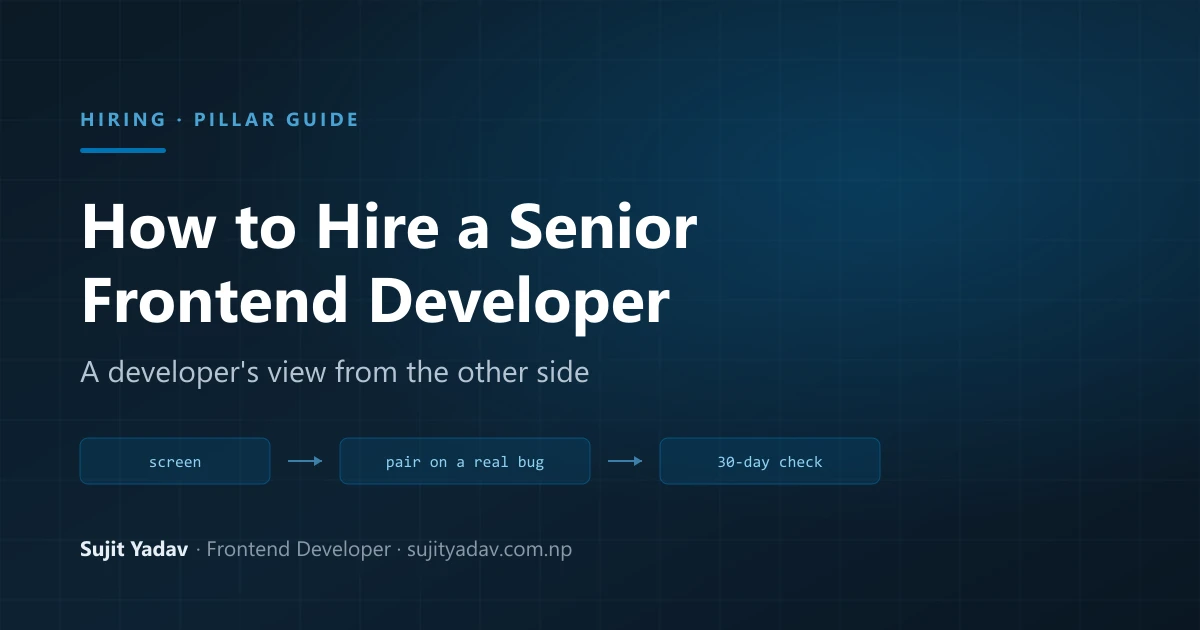
| Pairing on a real bug (60–90 min) | Debugging, reasoning aloud, collaboration | Low, and it is reciprocal | The single most predictive round |
| Code review of your code | Judgement, tact, seniority | Very low | Excellent, and badly underused |
If you run only one technical round, make it this one: take a real bug from your backlog, put it in a sanitised copy of your repository, and pair on it for an hour. It is the round I have learned the most from as a candidate, and the one where I have watched other developers reveal the most, because it cannot be rehearsed. You see how someone navigates an unfamiliar codebase, whether they read before they type, whether they form a hypothesis or start changing things, and how they behave when stuck — which is the actual job, most days.
The second-best round costs almost nothing. Send a pull request from your own history, including one genuine mistake, and ask them to review it. The comments they leave tell you more about seniority than any code they write. Watch whether they distinguish "this is wrong" from "I would do this differently," and whether they explain the why. As a bonus, this is the round candidates remember, because it is the first sign that a team actually wants to be argued with.
If you do use a take-home, scope it to two hours, say explicitly what you are and are not assessing, and never ask for work that resembles something on your roadmap. One thing I will say plainly from the candidate side: an unpaid take-home that looks like a ticket from your backlog is noticed every time, and it costs you the people you most wanted.
The architecture conversation that separates levels
One open-ended design discussion will spread your candidates out more than any other round. Pick something close to your product — "design the frontend for a dashboard where twelve widgets each load independently, some poll, and users can rearrange them" — then probe six areas.
- State. What is server state, and how is it cached and invalidated? What is URL state, and does a refresh preserve the view? What is genuinely local? A senior separates these without being asked. I have written about why this matters in why your Angular project needs a signal store, and the same reasoning applies in any framework.
- Rendering strategy. Client rendering, server rendering, static prerendering, streaming — and crucially why, given the SEO and interactivity requirements. Anyone who has actually shipped SSR raises hydration and duplicated data unprompted.
- Boundaries. What are the modules, what may import what, and is that enforced by tooling rather than by hope. Ask what happens when a second team arrives.
- Failure. What does the user see when one widget's API times out? Partial failure handling is a strong seniority marker, because it only comes from production experience.
- Performance budget. What number would they hold themselves to, and how would CI enforce it? Naming a metric and a threshold is a good sign.
- Accessibility. Keyboard reordering of those widgets, focus management, live region announcements. In 2026 this is also a legal question in the EU under the European Accessibility Act, so a senior candidate should treat it as a requirement rather than an extra.
You are not looking for a correct answer. You are looking for someone who asks what the constraints are before designing, states their assumptions out loud, and offers a simpler option alongside the thorough one.
Framework-specific questions worth asking
Frameworks are the easiest thing to bluff on paper and the easiest to verify in conversation, because depth shows up within two questions.
Angular
Ask how they think about signals versus RxJS, and when each is the right tool. Ask what would need to be true before they turned on zoneless change detection, and how they structure a large application so teams do not collide. Anyone claiming senior Angular in 2026 should be fluent in standalone components, built-in control flow, deferred loading and signal-based state — the full picture is in my guide to modern Angular development. A candidate still describing NgModules and manual subscriptions as current practice stopped learning somewhere around 2021.
React
Ask what actually causes a re-render, and what they reach for before adding a memo. Ask where they draw the line between server and client components, and what they have found painful about it in production. The uncertain answers are usually more informative than the confident ones — I collected the patterns that changed my own habits in React 19 patterns.
Next.js
Ask them to explain the caching model in their own words, and what they do when a page is stale when it should not be. Ask how they choose between static, revalidated and dynamic rendering for a given route. Caching is where Next.js projects go wrong, and everyone who has shipped one has a story; mine, arriving from Angular, is in journey from Angular to Next.js.
Across all three
Ask what they do about design consistency as a team grows. If they have lived through it, they will describe tokens, a shared primitive layer and governance rather than a components folder — the case I make in why every startup needs a design system. And if your product has an AI surface, ask how they would stop a model from deciding your UI; the architecture I settled on is in architecting an AG-UI frontend.
Red flags and green flags
A handful of signals come up again and again — in how engineering leaders describe their own hiring, and in what I can see afterwards in the code. These are the ones I would weight most heavily, and the red flags in particular are the ones whose consequences I have had to work inside later.
| Red flag | Why it matters |
|---|---|
| Recommends a rewrite before understanding the constraints | Rewrites are the most common way frontend teams lose a year |
| Cannot name a trade-off in a technology they love | Signals identity-based rather than evidence-based decisions |
| Every past failure was someone else's fault | You will be the next someone else |
| Talks only about tools, never about users or outcomes | Optimises for interesting work rather than valuable work |
| Dismisses accessibility or testing as things to add later | Both are architectural; retrofitting them costs multiples |
| Vague about what they personally built on a team project | Usually means less ownership than the CV implies |
| Green flag | Why it matters |
|---|---|
| Asks about your users, metrics and constraints early | They design for context, not for a portfolio |
| Describes a time they argued for the simpler solution | Restraint is the rarest senior trait |
| Has publicly changed their mind about something | Learning from production, not from conference talks |
| Explains a technical idea to you clearly, without condescension | Predicts review quality and cross-team work |
| Talks about incremental migration with real examples | The most valuable skill inside an existing codebase |
| Says "I do not know" and then reasons out loud | Honest calibration under uncertainty is the job |
In-house, agency or freelance
The employment model matters as much as the person, and the right answer depends on how long the work lasts and how much context it requires.
| Model | Time to productive | Best for | Main risk |
|---|---|---|---|
| In-house employee | 4–8 weeks, then compounding | Long-lived product, growing team, deep domain knowledge | Slow, expensive hire; a mistake takes months to unwind |
| Agency | 1–3 weeks | Fixed-scope delivery with a hard deadline and a clear spec | Context leaves with the team; you inherit code nobody there wrote |
| Independent contractor | 1–2 weeks | Specific expertise, a rescue, or building the first version | Availability and bus factor; needs a deliberate handover |
| Contract-to-hire | 1–2 weeks | Reducing risk on both sides before committing | Narrows the pool to people currently between roles |
A pattern that works well: bring in an experienced contractor to set the architecture and the first two months of conventions, and hire in-house alongside them so the knowledge stays. The failure mode to avoid is the reverse — hiring in-house first with nobody senior to set direction, then paying a contractor later to undo the result.
Cost, and what actually drives it
Rates vary enormously by location, and the honest framing is that you are not choosing between cheap and expensive developers so much as choosing which market you hire in. Treat the following as a rough orientation rather than data — it is drawn from public rate surveys, marketplace listings and the contracting conversations I have had myself, and it moves. For senior frontend contracting in 2026, North America and Western Europe commonly sit in the USD 80–160 per hour band, Eastern Europe and Latin America around USD 40–80, and South and Southeast Asia around USD 25–55. Agencies typically add 40–100 percent on top of whatever the individual would charge.
Two things are worth knowing about those numbers. First, the spread within any market is wider than the spread between markets: a genuinely senior developer anywhere costs several times a junior in the same city, and is usually cheaper per unit of shipped work. Second, the cheapest version of a frontend project is almost never the lowest rate — it is the one that does not have to be built twice. I have repeatedly been paid more to fix an application than the original build cost.
If you are hiring remotely across time zones, budget for the overlap rather than the rate. Four hours of genuine overlap makes a distributed team feel local; one hour makes every question cost a day. I work from Nepal with teams across Europe, the Middle East and North America, and the arrangement that consistently works is a fixed overlap window, decisions written down, and asynchronous updates that assume the reader was asleep.
Onboarding: the first thirty days tell you everything
Hiring does not end at the offer. The first month is your real evaluation, and a good senior developer will make it easy to assess them if you set it up properly.
- Day one: they ship something small to production. A copy change, a small bug. This tests your pipeline as much as them, and both are worth knowing.
- Week one: they write down what confused them. A fresh-eyes document is a genuine gift, and producing one tells you how they will document their own work.
- Week two: they own a real feature end to end — including the empty state, the error state and the keyboard path.
- Week three: they review someone else's pull request substantively. This is where seniority becomes visible to the rest of the team.
- Week four: they propose one improvement with a cost estimate. Not a rewrite: a scoped, justified change. What they choose tells you how they read your codebase.
If those five things happened naturally, you hired well. If you had to ask for each of them, you hired a strong mid-level developer — which is fine, as long as you know it and price the role accordingly.
A one-page hiring scorecard
Score each dimension one to five, agree the weights before you interview anyone, and have every interviewer submit independently before discussing. Discussing first is how a room converges on whoever was most confident.
| Dimension | What you are scoring | Typical weight |
|---|---|---|
| Architecture and judgement | State, boundaries, rendering strategy, knowing what not to build | High |
| Code and debugging | Reads before typing, forms hypotheses, writes readable code | High |
| Communication | Explains clearly, writes well, disagrees productively | High for remote |
| Product sense | Asks about users, pushes back on low-value work | Medium |
| Quality practices | Testing, accessibility and performance treated as requirements | Medium |
| Ownership | Follows through, surfaces problems early, mentors | Medium |
One rule seems to matter more than the scoring itself: if nobody in the room can articulate what this person would make measurably better in six months, do not hire them yet. Enthusiasm is not a finding.
The shortest version
Name the job before you post it. Write a description specific enough to repel the wrong people. Read portfolios for decisions rather than polish. Screen for texture in the stories. Replace the algorithm round with pairing on a real bug and a review of your own code. Probe state, boundaries, rendering, failure, budgets and accessibility in one design conversation. Weight restraint and changed minds heavily. Then treat the first thirty days as the last interview round.
Do that and you will hire slower and better — which, on the frontend, is the only version of faster that lasts.
And the caveat I opened with still stands: this is a developer's view, not a recruiter's. I do not know what it is like to have twelve people in a pipeline and a role you needed filled last month. What I do know is what the resulting codebase looks like a year later, and which parts of a hiring process told me something real about the team I was about to join. If a hiring manager reads only one line here, make it this one: put a candidate next to your actual code, with your actual constraints, and watch how they think. Everything else in this guide is a way of buying time for that hour.
I am Sujit Yadav, an Angular, React and Next.js developer based in Nepal, working remotely with teams worldwide. If you are hiring for exactly this role, you can look through the applications I have built, read where I have worked and on what, or get in touch — I am happy to start with the pairing session.